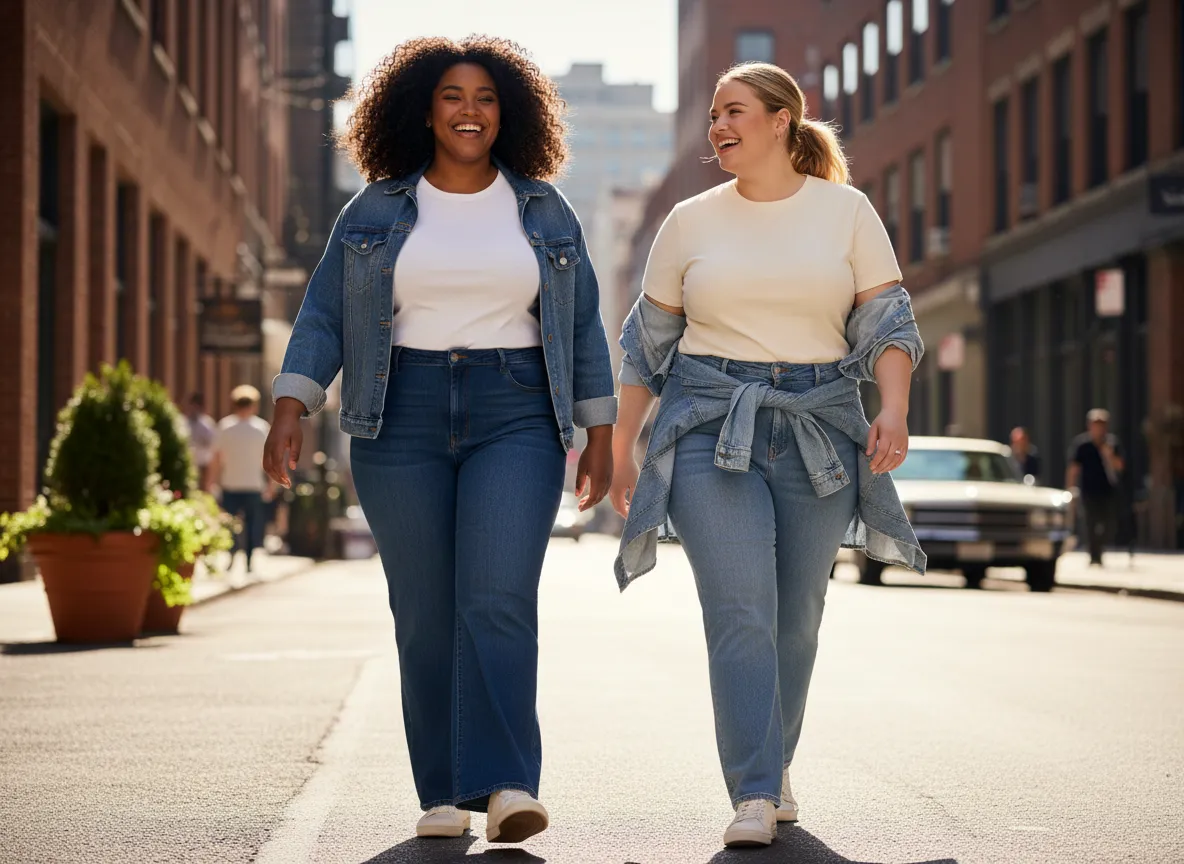
If jeans that fit your hips and thighs leave a gap at the back of your waist, there is nothing wrong with your body. Most denim is cut for a straighter frame, and that leaves curvy and plus-size women doing extra work in the fitting room. This guide explains why that happens and how to find jeans that fit comfortably from waistband to hem.
Quick answer
- Waist gaps happen when your hip-to-waist difference is bigger than the pattern was drafted for.
- Curvy fits add room through the hips and thighs while keeping the waist smaller.
- Plus sizes are a separate size range with their own proportions, not just larger straight sizes.
- Measure your waist, hips and inseam, and match them to each brand’s size chart.
- Stretch denim is forgiving; rigid denim holds its shape but needs a more exact fit.
Why the waist gap happens
Every jean is built on a pattern that assumes a certain difference between waist and hip measurements. If your hips are noticeably fuller than your waist, a pair that fits your hips will often be too big at the waist. Size down for the waist and the jeans feel tight through the seat and thighs. The fix is not to change your body. It is to find a cut drafted for your proportions. Our body shape guide can help you understand your own proportions before you shop.
Curvy fits explained
A curvy fit keeps the waistband proportionally smaller while adding room through the hips, seat and thighs. Many brands now offer one. A few we cover in our brand guides:
- Abercrombie Curve Love. Abercrombie’s curvy jean line, offered in five lengths that run from Extra Short to Extra Long.
- Madewell Curvy. Madewell makes curvy jeans alongside petite, tall and plus options.
- Free People CRVY. Free People’s CRVY denim is its curvy line, a good fit for a relaxed, boho wardrobe.
Curvy fits are not only for one size. They are about the ratio between your waist and hips, so they can work for a size 4 or a size 18. Find more ideas in our curvy style guides.
Plus-size jeans
Plus-size denim is cut on its own pattern, usually with more room through the rise, seat and thigh, and a waistband shaped to stay put when you sit. Two brands in our guides with strong plus ranges:
- Madewell offers plus sizes 14W–28W.
- Old Navy carries sizes 00–30, plus XS–4X, so many women can shop the same styles in one place.
Browse more plus-size outfit ideas in our plus-size guides.
Rises and leg shapes
Choosing a rise
High rise sits at or near your natural waist and is a favorite for curvy shapes because it follows the curve of the hip and keeps the waistband in place. Mid rise sits a little lower and feels relaxed. Low rise tends to slip and dig when you sit, so most curvy and plus-size women find it the least comfortable. Choose the rise that feels good at your waist when you sit, not just when you stand.
Leg shapes at a glance
| Leg shape | Who it suits | Styling tip |
|---|---|---|
| Skinny | Anyone who likes a close fit; easy under boots | Balance with a longer top or an open shirt |
| Straight | Almost everyone; the easiest everyday cut | Tuck or half-tuck a tee to show your waist |
| Wide-leg | Curvy hips and fuller thighs; adds movement | Pair with a fitted top and a shoe with some height |
| Bootcut | Hourglass and fuller-hip shapes; balances the hip line | Wear with heeled boots or platform sandals |
| Barrel | Those who want a relaxed, curved leg | Keep the top simple and fitted at the waist |
Fabric and stretch: rigid vs. stretch
Check the fabric content on the tag before you try anything on.
- Rigid denim (100% cotton) holds its shape, looks classic and softens with wear, but needs a more exact fit at the waist and hips.
- Comfort stretch (a small amount of elastane) is the sweet spot for many curvy women: structure plus a little give when you sit.
- High stretch moves with you and is the most forgiving at the waist, but can loosen during the day. Many people size down when they shop high-stretch styles.
How to measure for jeans
Use a soft measuring tape and stand relaxed.
- Waist: measure where you want the waistband to sit. For high rise, that is usually your natural waist.
- Hips: measure around the fullest part of your hips and seat, keeping the tape level.
- Thigh: measure around the fullest part of one thigh. This helps if thighs are your usual tight spot.
- Inseam: measure a pair of jeans you love from the crotch seam to the hem.
Plug your numbers into our size calculator for a starting point, then compare against each brand’s chart.
When you are between sizes
Fit your hips first, because a waistband is easier to take in than a seat is to let out. In stretch denim, the smaller size is often the right call; in rigid denim, the larger size usually wins. If the hips fit but the waist gaps, that is your sign to try a curvy cut. A tailor can also take in the back of the waistband if you have found a pair you love.
Budget picks
Great-fitting jeans do not have to be a splurge. Old Navy is a strong budget option thanks to its wide size range, so it is a good place to experiment with new leg shapes before investing elsewhere. See more wallet-friendly ideas in budget finds, and build easy outfits around your new pair with our weekend and casual outfits.
Related: Ready to shop? See our picks for the best jeans for curvy women.
FAQ
What is the difference between curvy and plus-size jeans?
Curvy refers to proportion: more room in the hips and thighs relative to the waist. Plus-size refers to a size range. You can be one, the other or both.
How do I stop jeans from gapping at the back?
Try a curvy fit and a high rise, or have a tailor take in the back waistband.
Should jeans feel tight when I buy them?
Snug but comfortable. Stretch denim relaxes with wear, so it should not feel loose on day one. You should be able to sit without the waistband digging in.
Keep reading: curvy style guides, our complete size guide and the Madewell brand guide.

Leave a Reply